
Home / Guides / Getting it down the stairs
Whatever got up there comes back down.Getting It Down the Stairs
The most common thing anyone says before booking us is a version of the same worry: it will never fit down our stairwell. It nearly always does, and this page is the long answer to why. How a couch actually turns a half-landing, what we take off to make a doorway wider, what we lay down so your rented walls stay unmarked, and the one honest measurement that decides the whole thing. Not the couch. The landing.
Measure the landing, not the couch
Almost everyone measures the wrong thing. They stand the couch up, eye the doorway, count the flights, and talk themselves into a problem. But the length of your couch is rarely what stops it, and the number of stairs never is. What decides a walk-up carry is the room to turn: the floor space on the half-landing where the stair doubles back, and the narrowest pinch point on the way out.
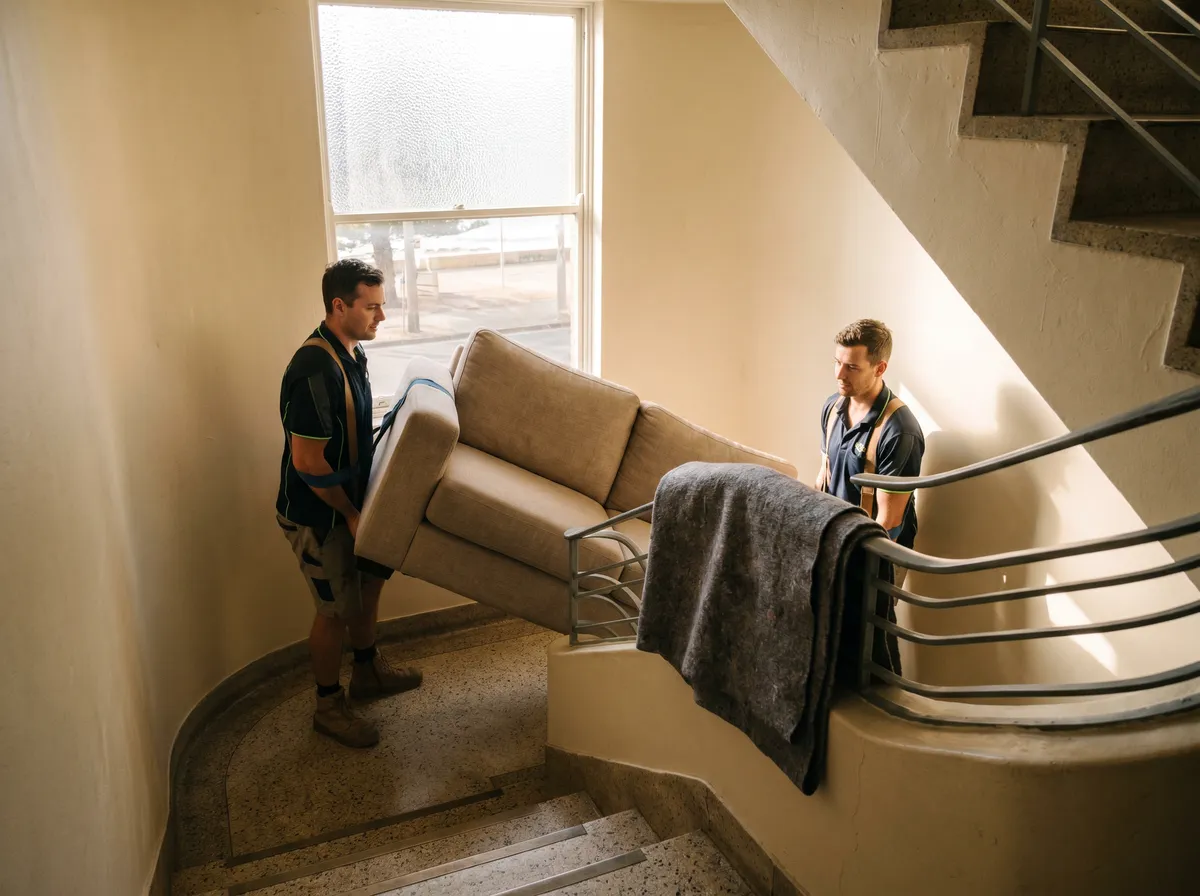
A three-seater is long, but on a landing it does not travel flat and level. It goes down on one end, tipped and pivoted through the corner like a hand on a clock, so the space it needs is the landing's diagonal, not its own length laid out straight. Deco and red-brick walk-ups in Manly were built with generous half-landings for exactly this reason: people have always had to get furniture up and down them.
So when we look at a job, we are reading the turn, the balustrade, the doorway at its skinniest, and whether a door needs to come off. Get those right and the stairs are just stairs. That is also why the stairs check asks about your flights and your building, not the dimensions of your sofa.
What you are picturing, and what actually decides it
Nine times out of ten the thing you are anxious about is not the thing that matters. Here is the swap, played straight, so you can stop worrying about the wrong column.
Usually fine
- The number of flights. Three floors is more trips, not more trouble. We plan the rest breaks, not the surcharge.
- The weight. Two people and the right straps move a full fridge down a flight one controlled step at a time. Heavy is a technique, not a wall.
- The length of the couch. Long things pivot. It is the turning room that counts, not the tape measure down the side of the sofa.
- No lift. The walk-up is the default here, not the exception. It is what the crew and the van are built around.
What we actually check
- The half-landing turn. Enough floor to swing the longest item around the corner. This is the real question, every time.
- The narrowest pinch. A skinny doorway, a tight lobby, a jog in the hall. We find the tightest point and plan the item to it.
- A fixed balustrade or low rail. Something you cannot lift over or slide past changes the line down, so we look before we lift.
- Whether a door comes off. Five minutes with a hinge often turns a maybe into an easy yes.
And on the rare job where something genuinely cannot round a tight corner in one piece, there is still a plan: most furniture comes apart further than people think, and a wrapped item can go down on a strap or out through a wide opening. We work that out before the day, not halfway down with your wardrobe wedged against the balustrade.
How we actually bring it down
None of this is heroics. It is a handful of dull, reliable techniques done in the right order, which is exactly why it works on a terrazzo landing without a scratch and without a drama. The kit lives in the van and comes up with us.
Straps and the two-person carry
Forearm forklift straps and shoulder dollies take the load off backs and hands, so the item is controlled the whole way down rather than gripped and hoped. Two people, one leading and one taking the weight, moving in step.
The pivot and the tip
Long, tall and bulky things travel on an end or an edge, pivoted through the turn like the diagram above. It looks slow because it is deliberate: momentum is the enemy on a staircase, not the friend.
Doors, legs and hinges off
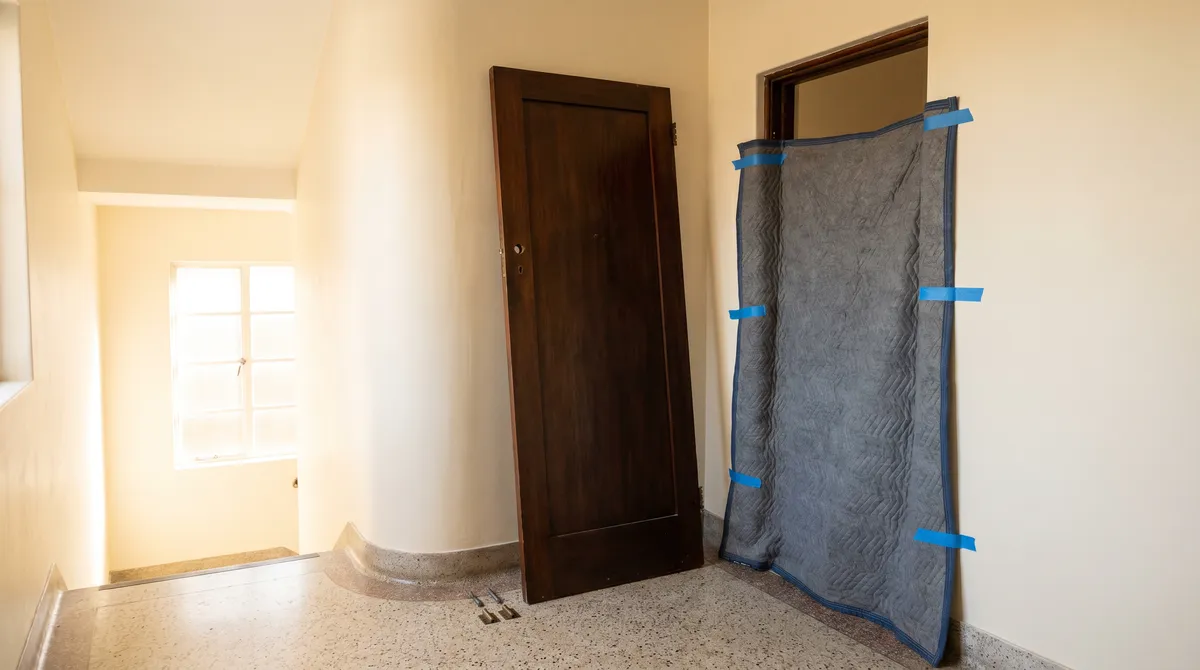
A room door lifted off its hinge pins buys you a wider doorway in five minutes. Sofa legs, bed frames and flat-pack come apart the same way, and go back to being furniture-shaped once they are outside.
Corners, rails and floors protected
Moving blankets over the balustrade corner and the doorframe, the self-closing lobby door propped so it stops ambushing us, and a clear path planned before the first lift. The building should never know we came.
How each thing actually leaves a walk-up
The items people most often think are stuck. Each one has a well-worn way down that we have done more times than we can count in these buildings.
The couch and the sofa bed
The classic Manly single item. Legs off if they are on, tipped and pivoted around the turn, walked out on straps. The sofa bed is heavier and hides a steel frame, so it earns two proper lifters and a slower turn. It still comes.
The mattress and the base
A mattress is the easy one: it flexes, folds through a doorway and half-walks itself down under control. The bed base or ensemble is the awkward half, often split into two or stood on its edge for the turn. Both are recycling streams, handled properly, not skipped.
The fridge, washer and white goods
Strapped upright to a stair trolley or shouldered between two, taken one step at a time, doors kept on until it is out and safe. The salt-air fridge death is real here. It goes to a licensed facility, not the kerb.
The wardrobe and flat-pack
The honest answer: a full-height wardrobe usually comes apart rather than down whole, because it was built in the room. Flat-pack returns to flat. That is quicker and gentler on your walls than wrestling a two-metre box around a landing it was never going to clear.
Glass, mirrors and the awkward one
Glass tabletops, mirrors and the cracked cabinet get wrapped and carried flat and slow, because glass on a staircase is the one thing worth being fussy about. The exercise bike with regrets and the rolled rug ride down the same way, without fuss.
The balcony or cage pile
When the balcony became the shed, we carry the lot back through the flat or down the fire stairs, whichever keeps the common areas cleanest. Storage cages in the basement work the same way, cleared and swept, building manager kept happy.
What we protect on the way out
In a block of flats the stairwell belongs to everyone, and if you are renting, so does your bond. So the carry is built around leaving no trace, not just shifting the load. That is not a favour, it is the job.
Blankets go over the balustrade corners and the doorframe the item has to pass. The self-closing lobby door gets propped so it cannot swing into anyone. The path is walked first and cleared of the doormat, the shoe rack and the pot plant that would otherwise become a casualty. Terrazzo, tile and timber all get treated like they are somebody's, because they are.
Then the shared spaces go back exactly as they were, swept if we made a mess, so the strata, the building manager and the neighbour on level two never get a reason to send an email about it. Nothing gets parked in the lobby, and nothing gets left on the kerb.
Want to sanity-check it yourself first?
If you like a tape measure, these are the four things worth a look. You do not need to. We check them on arrival either way, and getting it wrong is our lesson, not your bill.
- The pinch. Find the narrowest doorway or hall the item must pass. That number, not the couch length, is the one that matters.
- The turn. Stand on the half-landing where the stairs double back. Could you swing a broom horizontally there? If yes, the couch turns too.
- The rail. Note any fixed balustrade or low wall you cannot lift over. It changes the line down, nothing more.
- The lift. If there is one, check whether it needs booking with the strata, and roughly what fits inside it.
Or skip the tape measure
The stairs check does the same reasoning in about sixty seconds. Tell it what is going, how many flights, and whether there is a lift, and it gives you a plain-language read: how many of us, how many trips, and how the fixed price works. No measuring, no maths.
It is deliberately not a price. The whole number gets settled in person once we have stood in front of the pile and counted the landings, and before a thing is lifted. The stairs are in it. They are never a line added on top.
Stairs questions, straight answers
It barely fit coming in. Will it come back out?
Yes, and usually more easily than it went in, because whoever brought it up may not have known the tricks. If it made the turn once it makes it again, and if it was carried up assembled we can often take it down in pieces. The building has not shrunk since delivery day.
Third floor, no lift. Is that a problem, or a surcharge?
Neither. Around three in four homes here are walk-ups, so stairs are the normal condition, not a special case. The flights are counted as work we plan around, and they are folded into the one fixed price you agree before we lift. There is no per-floor line and no stairs fee. The small-loads page spells out the model.
Do I have to take the door off myself before you come?
No, please leave it to us. Lifting a door off its hinge pins takes a couple of minutes and we hang it straight back afterwards. If you have already cleared the path of the doormat and the shoe rack, that helps, but the doors, the straps and the protection are ours to handle.
What if it genuinely will not fit down the stairs?
It is rare, and we would rather find out before the day than on the turn. Most large furniture comes apart far enough to solve it. When it truly cannot, a wrapped item can sometimes go down on a strap or out through a wide opening or balcony, and if even that is not safe we will tell you honestly and point you to the right specialist rather than force it and damage your building.
I am renting. Will you mark the walls or the common areas?
That is exactly what the blankets, the propped door and the walked path are for. The whole carry is built to leave no trace in a shared stairwell, because your bond and the strata's patience both depend on it. We sweep up behind us, so the shared landing looks untouched by the time we drive off.
Can you get the balcony pile down without traipsing through the flat?
Where the building allows it, yes, we will use the fire stairs or the closest run to keep your hallway and the common areas clean. Whichever route makes the least mess is the one we take, and the balcony comes back to being a room you can sit on. That is the whole of balcony and cage reclaims.
Tell us what needs to go
Fill in the form and the callback comes from the crew, not a call centre. We look at the load, the whole number is settled before the first lift, stairs and all. Then it is carried down, swept up and gone, never left on the kerb.
- Small jobs taken seriously, one couch is plenty
- Fixed price agreed up front, no hourly surprises
- Same-day where we can, booked around your building